



Join me for a weekend that promises to be informative, educational and, more importantly, entertaining. There will be giveaways, there will be camp-fire tales and there will be LOTS of photography. Don’t delay, there are only 6 spaces available. For more information, contact me on [email protected]

This is a Southern Yellow-Billed Hornbill, NOT Zazu from the Lion King!
Fun fact: The instant Disneyfication of species usually extends to This bird and warthogs( Pumba) I have never been on a drive where any of the other Lion King names are used by guests (Field guides are cautious to use the correct terminology when referring to species)

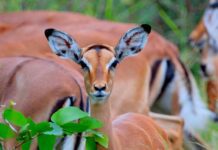
Did you know that Impala are good at First Aid? Here an Impala ewe is about to carry out a hind lick manoeuvre.
FYI: Impalas perform both self-grooming and allogrooming. This is social grooming where animals will groom each other. While females are usually seen grooming related animals, males will groom unrelated ones.

A European Bee-eater sits quietly on a branch.

A beautiful bird with an ugly call, The stunning Lilac-breasted Roller. I suppose you cannot have everything. Their call can be likened to the incessant barking of a small dog.

The old Roger Miller song, “King(s) of the Road was playing in my head when we came across this walking roadblock.

One of the fastest antelope in Africa…The Red Hartebeest, which can reach speeds of up to 55kph.
FYI: The fastest African antelope is the Tsessebe, which can run at over 90 kph. They are followed by Springbok (88kph), Blue Wildebeest (80kph) and Impala (80kph)

A Rufous-naped Lark calling to make certain that other males respect its territory.Or to attract a possible mate.

A White Rhino and calf. Due to the fact that both White and Black species are, in fact, grey, many field guides are referring to them as “Wide lipped” of “Hooked Lip” rhino.
FYI: White Rhino are the 9th fastest African animal and can attain speeds of up to 50kph, and are able to run faster than any living human and often, depending on the terrain, even a game drive vehicle!

Lashes to be jealous of? A female giraffe looks straight into my lens.
FYI: Long eyelashes on a giraffe are not merely cosmetic. They protect the eyes when the animals are browsing from their favourite food source…the extremely thorny Acacia Trees. In 2011, the name ‘Acacia’ was reserved for the species found in Australia while in Africa, they were renamed either ‘Vachellia’ or ‘Senegalia’ depending on certain botanical characteristics of the tree.

From Russia with love. A migratory Steppe Buzzard keeps an eye open for a feeding opportunity. These raptors arrive in South Africa in September and leave again for Europe in March. So I count myself fortunate to have seen this particular individual.

The devil-eyed Arrow Marked Babblers. These noisy birds can often be found in the car parks of game lodges, or in areas where they know there are humans that will invariably leave something edible behind when they leave. Often in a flock where their squabbling can create quite a ruckus.

A shitty job, but someone has to do it. A Dung Beetle pushing this perfectly formed sphere along as he tries to attract a mate and keep other males off the ball.
Did you know? A dung beetle is considered the heavyweight champion of the insect world. It can move 1,141 times its own body weight! That would be like a 70kg person being able to lift the mass of 6 double-decker buses.

A Swainson’s Spurfowl in a commanding position. Their alarm call can, sometimes, be the precursor to a predator sighting.

A Black-shouldered Kite looks down for potential prey. Their almost iridescent red eyes and striking plumage makes them instantly recognizable.

A Yellow-billed Oxpecker cleans up a Wildebeest. Unlike certain bird species that will follow animals, catching insects that their hooves disturb, this species has a symbiotic relationship with the animals that they feed on. The Oxpecker gets a meal and the animal gets rid of parasites and ticks in hard to reach places.
Important fact: If you do a lot of trails walking and you learn the call of this bird it might save your life one day. Their alarm call often means the presence of large dangerous game species, like rhino and buffalo.

Grass…you can smoke it or eat it… And this particular Zebra has chosen to do the latter. An early morning snack before getting down to the business of the day…eating more grass.

A Helmeted Guineafowl caught in the early morning light. These birds will only fly when absolutely necessary. They will often run for hundreds of meters in front of a game drive vehicle before either flying off or veering into the grass on the side of the track.

A Leopard Tortoise…the only tortoise species that can swim. Not only can they swim, but they can stay underwater for an extended period of time. They should not be confused with a Freshwater Terrapins, which are a totally different shape and size.

And now for the Gnus…Although the Blue Wildebeest (Connochaetes taurinus) is referred to as a Gnu, it is the Black Wildebeest (Connochaetes gnou) that has the “gnu” in its Latin name.
Fun Fact: The collective noun for Wildebeest is a confusion! An apt description indeed!

Power to the people? Not in South Africa with the current load shedding crisis. I am of the opinion that power lines will eventually vanish when solar and wind-assisted energy sources are harnessed and used correctly. But, until then, I will utilize these “ballerinas of the bushveld” rather than ignore them

Listen to the interview that I did with RJ, the field guide during my stay at Black Rhino Game Lodge. He has been in the guiding industry for almost 4 years and I chatted to him about his career path and where he sees currently and going forward.

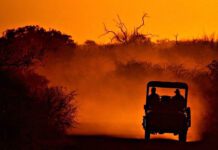
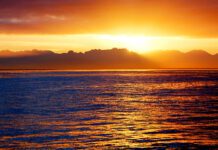
Back at the lodge, watching the sunset… A perfect ending to yet another wonderful day in the African bush.

All images are the copyright property of

and may not be used without permission.